Silver spot: $57.83/oz · Updated July 21, 2026 12:03 AM ET · Live silver spot chart
Half Dollar Melt Values — Every U.S. Silver Half Dollar
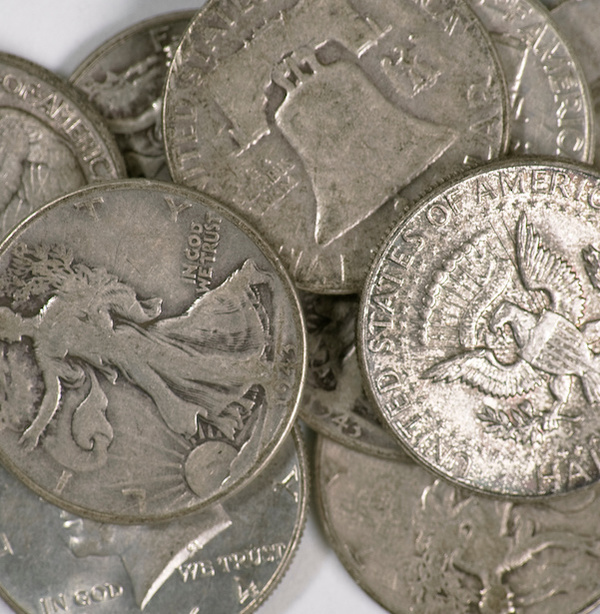
Five U.S. half dollar series carry silver content in two compositions. Barber, Walking Liberty, Franklin, and the 1964 Kennedy are 90% silver at 0.3575 troy oz ASW. The 1965-1970 Kennedy is 40% silver at 0.147893 troy oz ASW. The 1964 Kennedy is the dividing line: 1964 and earlier is 90%, 1965 through 1970 is 40%, and 1971-onward circulating Kennedys are clad with no silver.
Silver spot today: $57.83/oz. A 90% silver half is worth $20.67 at melt; a 40% Kennedy half is worth $8.55.
← All U.S. silver coin melt values
Half Dollar Melt Value Calculator
Quick reference — what one silver half is worth
| Composition | Years | ASW (troy oz) | Melt value at $57.83/oz |
|---|---|---|---|
| 90% silver | 1892-1964 | 0.3575 | $20.67 |
| 40% silver | 1965-1970 | 0.147893 | $8.55 |
Junk silver bag math:
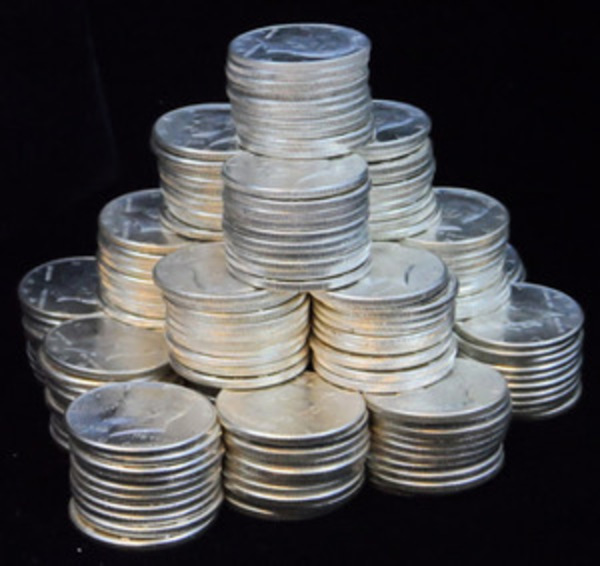
- $10 face of 90% halves (20 coins): 7.15 troy oz silver (melt: $413.48).
- $10 face of 40% halves (20 coins): 2.958 troy oz silver (melt: $171.06).
- $100 face of 90% halves: 71.5 troy oz silver (melt: $4134.85).
- $100 face of 40% halves: 29.58 troy oz silver (melt: $1710.61).
40% halves trade at a meaningful discount per face dollar to 90% halves, matching the silver-content gap.
U.S. Silver Half Dollar Series
Barber Half Dollar (1892-1915)
The shortest-running silver half dollar series and the rarest in junk silver bags. Most surviving examples are heavily worn from circulation, but key dates carry significant premiums regardless of grade.
Key dates: 1892-O, 1892-S, 1893-S, 1896-S, 1897-O, 1897-S, 1913, 1914, 1915-S.
ASW: 0.3575 troy oz, composition: 90% silver and 10% copper, total weight: 12.50 g, diameter: 30.6 mm.
Barber Half Dollar melt value page →
Walking Liberty Half Dollar (1916-1947)
Adolph Weinman's Walking Liberty design ran 32 years across two world wars and the Great Depression. It remains one of the most collected U.S. silver half series.
Key dates: 1916-D, 1917-S obverse, 1921, 1921-D, 1921-S, 1938-D.
ASW: 0.3575 troy oz, composition: 90% silver and 10% copper, total weight: 12.50 g, diameter: 30.6 mm.
Walking Liberty Half Dollar melt value page →
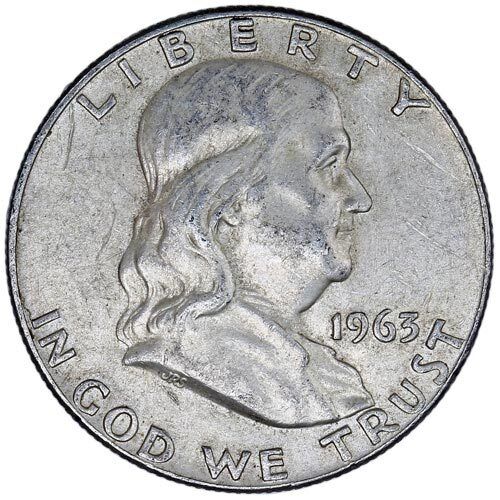
Franklin Half Dollar (1948-1963)
Franklin halves ran for 16 years and were replaced by the Kennedy half after 1963. There are no severe key dates, so values are generally driven by silver content and grade, with Full Bell Lines examples carrying premiums.
ASW: 0.3575 troy oz, composition: 90% silver and 10% copper, total weight: 12.50 g, diameter: 30.6 mm.
Franklin Half Dollar melt value page →
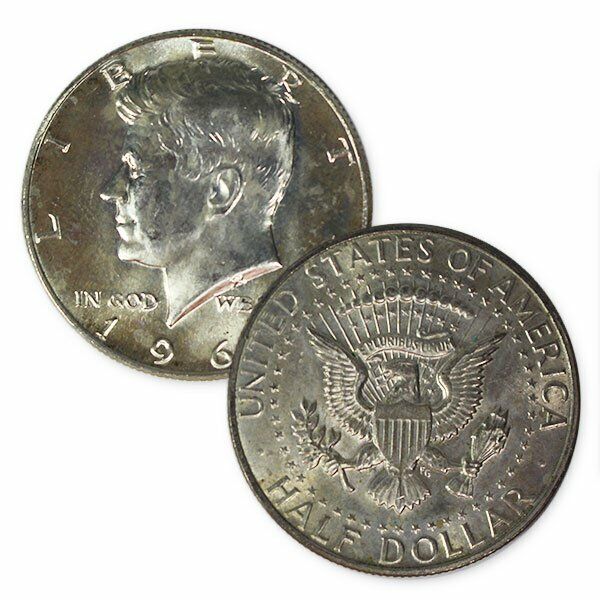
Kennedy Half Dollar — 90% Silver (1964 only)
The only 90% silver Kennedy and the last 90% silver circulating U.S. coin. It was authorized and struck on an accelerated schedule after the assassination in late 1963.
ASW: 0.3575 troy oz, composition: 90% silver and 10% copper, total weight: 12.50 g, diameter: 30.6 mm.
1964 Kennedy Half Dollar melt value page →
Kennedy Half Dollar — 40% Silver (1965-1970)
The transition composition after the Coinage Act of 1965. These coins used a 40% silver clad construction and remained in production for six years before circulating Kennedys went fully clad.
ASW: 0.147893 troy oz, composition: 40% silver clad, total weight: 11.50 g, diameter: 30.6 mm.
1965-1970 Kennedy Half Dollar melt value page →
The 40% Kennedy is also covered in the 40% silver coin melt values guide.
Composition and History
The U.S. struck silver half dollars in 90% silver from 1796 through 1964, then moved to 40% silver from 1965 through 1970 as a transition, and finally to clad starting in 1971. For background, see the end of silver in U.S. coins.
How to Identify a Silver Half Dollar
- 1964 or earlier: 90% silver.
- 1965-1970: 40% silver (Kennedy only).
- 1971 or later: no silver in circulation issues.
Weight check: 90% is 12.50 g, 40% is 11.50 g, clad is 11.34 g.
Where to Buy and Sell Silver Halves
- Browse silver half dollars
- 40% silver Kennedy bags
- Compare junk silver bag prices
- Find halves closest to spot
Frequently Asked Questions
How much silver is in a half dollar?
Depends on year. 1892-1964 is 0.3575 troy oz, 1965-1970 Kennedy is 0.147893 troy oz, and 1971 onward has no silver in circulation issues.
What years of half dollars are silver?
1892 through 1970: Barber, Walking Liberty, Franklin, 1964 Kennedy (90%), and 1965-1970 Kennedy (40%).
Why is the 1964 Kennedy 90% silver but the 1965 isn't?
The Coinage Act of 1965 removed silver from dimes and quarters and reduced halves to 40% silver.
Are 40% Kennedy halves a good investment?
They are often the lowest-premium per-ounce entry into physical silver but can be less liquid than 90% halves.
What's the most valuable silver half dollar?
The 1916-D Walking Liberty Half is the top regular-issue key date, with Barber keys also carrying strong premiums.
Related
- All silver coin melt values (master hub)
- 40% silver coin melt values
- Silver Quarter Melt Values
- Silver Dime Melt Values
- Silver Dollar Melt Values
- Junk silver collection — compare current prices
- Silver half dollars — browse dealer listings