Most precious metals investors start with gold and silver — the two metals that dominate headlines, dealer inventories, and retirement accounts. But a portfolio concentrated entirely in gold and silver misses one of the most compelling opportunities in the bullion market: platinum.
Platinum trades at a fraction of the gold price, yet it’s roughly 30 times rarer in the Earth’s crust. That disconnect between scarcity and price is what draws sophisticated investors to 1 oz platinum coins as a portfolio diversifier.
Why Platinum Deserves a Place in Your Stack
Platinum’s investment case rests on fundamentals that gold and silver don’t share.
Supply concentration creates volatility — and opportunity. Over 70% of the world’s platinum comes from South Africa, with Russia contributing most of the remainder. Any disruption — labor strikes, power grid failures, sanctions — tightens supply almost immediately. Gold and silver mining, by contrast, is spread across dozens of countries. This concentration means platinum can move independently of gold, which is exactly what diversification is supposed to accomplish.
Industrial demand puts a floor under the price. Platinum is essential in catalytic converters, hydrogen fuel cells, petroleum refining, and medical devices. Unlike gold, where industrial use accounts for a small share of demand, roughly a quarter of all platinum goes to industrial applications. When the economy grows, industrial demand competes with investment demand for a limited supply.
The gold-to-platinum ratio signals relative value. Historically, the price of platinum traded at a premium to gold for most of the 20th century. Trading activity in recent years shows the gold to platinum ratio providing contrarian investors with a potential asymmetric opportunity.
Comparing Premiums: What Platinum Coins Actually Cost
One thing that surprises new platinum buyers is how premiums compare to gold and silver. Because the platinum coin market is smaller and dealer inventories are thinner, premiums over spot tend to run higher than gold coins but can vary significantly between dealers.
This is where comparing prices across multiple dealers matters most. A $30–$60 premium difference on a single 1 oz platinum coin is common, and those savings compound quickly when you’re building a position over time. Use the platinum coin comparison page to see real-time pricing from multiple dealers side by side.
Five Major Platinum Bullion Coins Worth Knowing
Five government mints produce investment-grade platinum coins with global recognition, high liquidity, and guaranteed purity. Here’s what sets each apart.
American Platinum Eagle
The American Platinum Eagle is the only platinum bullion coin issued by the U.S. Mint, first introduced in 1997. Struck from .9995 fine platinum, each coin carries a $100 face value — the highest denomination of any U.S. bullion coin.
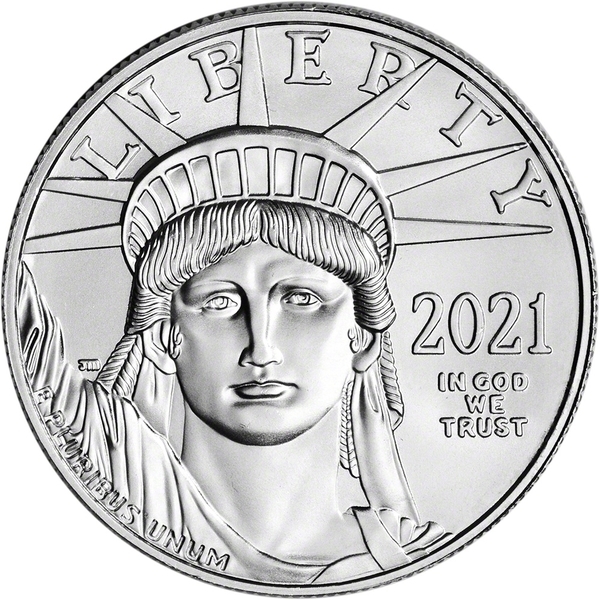
The obverse features John Mercanti’s “Portrait of Liberty,” while the reverse displays Thomas D. Rogers’ design of an eagle soaring over America’s landscape. The Eagle’s legal tender status and U.S. Mint pedigree make it IRA-eligible, which matters for investors using a self-directed precious metals IRA.
Premiums on American Platinum Eagles tend to run higher than foreign-minted platinum coins due to strong domestic demand and the U.S. Mint’s production volumes. Compare current dealer pricing for the American Platinum Eagle.
Platinum Britannia
The Royal Mint’s Platinum Britannia has become a favorite among premium-conscious buyers. It consistently carries one of the lowest premiums of any government-issued platinum coin, making it an efficient way to accumulate platinum close to spot.
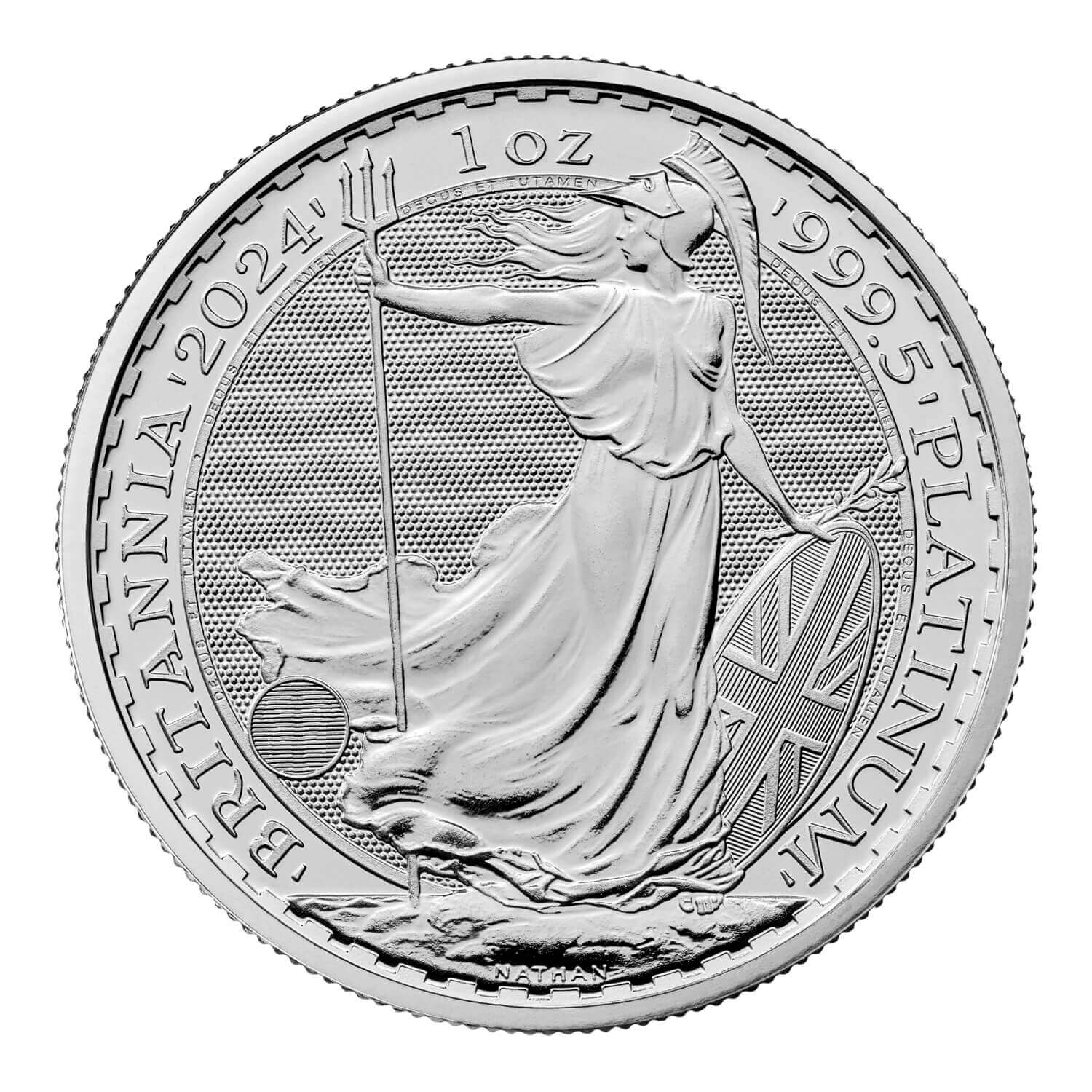
The reverse features Philip Nathan’s iconic depiction of Britannia — the mythical warrior standing guard on the southern coast, trident in hand, shield bearing the Union Jack. The obverse displays the current reigning monarch’s portrait.
Available in both 1 oz and 1/10 oz fractional sizes, the Britannia offers flexibility for investors who want to dollar-cost average into platinum with smaller purchases. Check current Britannia pricing across dealers.
Platinum Maple Leaf
The Royal Canadian Mint introduced the Platinum Maple Leaf in 1988, and it remains one of the purest platinum coins on the market at .9995 fine. Each coin carries a $50 CAD face value.
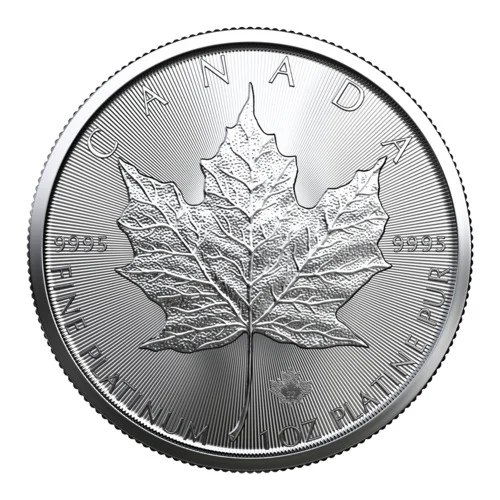
The reverse displays the signature maple leaf — Canada’s national symbol — alongside the coin’s weight and purity markings. The RCM’s advanced security features, including micro-engraved laser marks on modern issues, make Maple Leafs among the hardest bullion coins to counterfeit.
Premiums on Platinum Maple Leafs typically fall between the Eagle (higher) and the Britannia (lower), offering a middle-ground option with excellent global liquidity. See the latest dealer prices for the Platinum Maple Leaf.
Platinum Vienna Philharmonic
The Austrian Mint’s Platinum Philharmonic celebrates the Vienna Philharmonic Orchestra, one of Europe’s most prestigious cultural institutions. Struck in .9995 fine platinum, the coin mirrors the beloved design of its gold and silver counterparts.
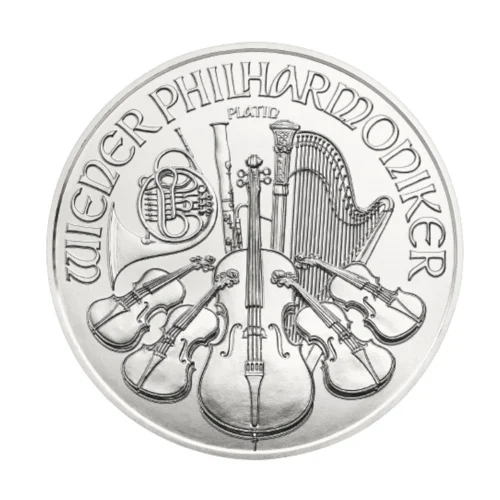
The obverse features the great organ of Vienna’s Musikverein concert hall, while the reverse depicts an arrangement of orchestral instruments — violins, cello, bassoon, harp, and Viennese horn.
The Philharmonic is legal tender in the eurozone, denominated in euros, which gives it broad recognition across European dealers and markets. Compare Platinum Philharmonic prices to see how premiums stack up.
South Africa Big 5 Series
South Africa’s Big 5 series showcases the continent’s most iconic wildlife — elephant, lion, buffalo, rhinoceros, and leopard — on .9995 fine platinum coins from the South African Mint.
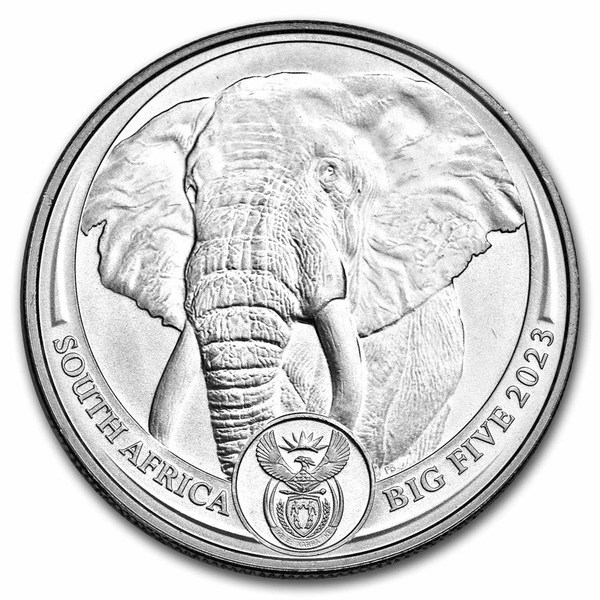
South Africa produces the majority of the world’s platinum, so there’s a fitting connection between the metal’s origin and the mint that strikes these coins. The Big 5 series rotates designs across the five animals, with each release featuring detailed, lifelike depictions that appeal to both investors and collectors.
Because Big 5 platinum coins are produced in lower mintages than Eagles or Maple Leafs, they can carry slightly higher premiums but also hold stronger secondary market value. Check availability for the Big 5 Platinum Elephant.
Vintage Platinum: Nobles, Shooting Thalers, and Engelhard Bars
Platinum’s history as an investment metal is shorter than gold or silver, which makes vintage platinum pieces genuinely scarce.
The Isle of Man Noble
The first dedicated platinum investment coin was the Noble, issued by the Isle of Man beginning in 1983. Unlike conventional bullion coins, the Noble isn’t denominated in any national currency — it’s measured in “nobles,” a nod to platinum’s historic prestige. These coins were marketed as pure bullion plays, and surviving examples from early production years command collector premiums above their melt value. See pricing for the Platinum Noble.
Swiss Shooting Thalers
During the 1980s, the Austrian Mint produced the Shooting Thaler 1 oz platinum coin as part of a Swiss tradition of commemorating the Schützenfest (shooting festival). The obverse features William Tell, the Swiss folk hero known for his legendary marksmanship. These Shooting Thaler coins appeal to collectors who want bullion-weight platinum with historical character.
Engelhard Platinum Bars
Engelhard’s connection to platinum runs deep — the company developed the first production catalytic converter in 1973, which drove industrial platinum demand through the roof as environmental regulations mandated catalytic converters worldwide. Engelhard capitalized on the resulting investor interest by producing platinum bars that became staples of the 1980s bullion market.
Today, vintage Engelhard 1 oz Platinum Bars carry brand premiums above generic bars, similar to how vintage Engelhard silver bars command a markup. They appeal to investors who value the combination of platinum’s intrinsic worth and Engelhard’s legacy as a foundational name in precious metals refining.
How to Start Building a Platinum Position
For most investors, platinum works best as a 5–15% allocation within a broader precious metals portfolio. Here are three practical approaches:
Start with a single 1 oz coin. Choose whichever mint offers the lowest premium at the time you buy — that’s the advantage of comparing across dealers before purchasing. The platinum coin comparison page shows you which coin is closest to spot right now.
Use fractional coins for dollar-cost averaging. The 1/10 oz Britannia lets you add platinum in smaller increments, smoothing out your cost basis over time without requiring a large lump-sum purchase.
Consider platinum for your IRA. American Platinum Eagles and certain other .9995 fine platinum coins are eligible for self-directed precious metals IRAs. If you’re already holding gold or silver in an IRA, adding platinum increases diversification within the tax-advantaged wrapper.
The Bottom Line
Platinum’s combination of extreme rarity, concentrated supply, strong industrial demand, and a historically low price relative to gold makes it one of the most overlooked opportunities in the bullion market. Five major government mints produce investment-grade platinum coins with guaranteed purity and global liquidity, and vintage pieces offer additional character for investors who value provenance.
The key to buying platinum efficiently is the same as any bullion purchase: compare premiums across dealers before you buy. Even small differences in premium add up across multiple purchases — and platinum’s thinner market makes those differences larger than what you’d see with gold or silver.