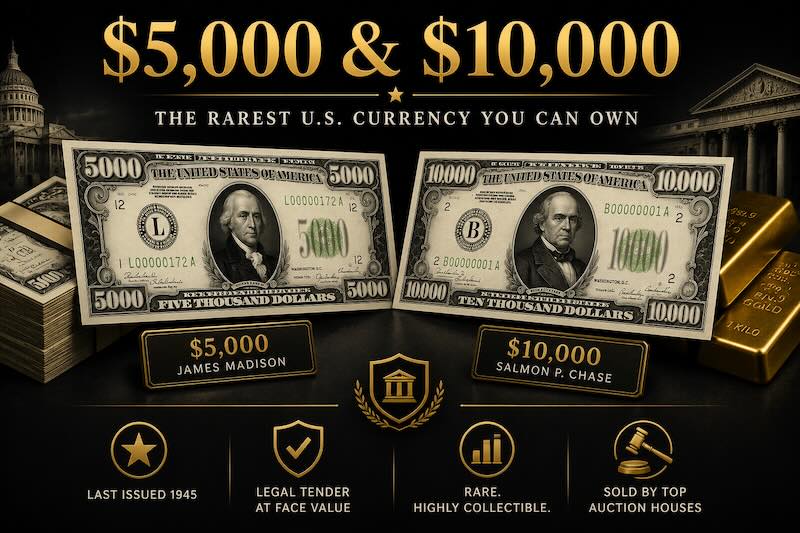
The $5,000 and $10,000 bills are the rarest US currency you can legally own. Fewer than 350 of each denomination survive — 342 and 336 known examples, respectively — most in institutional or advanced private collections. These aren’t notes you find at a coin show. They’re six-figure assets that trade through Heritage Auctions, Stack’s Bowers, and a handful of specialist dealers.
Both denominations were printed for the 1928 and 1934 series, last issued in 1945, and discontinued in 1969 alongside the $500 and $1,000. They remain legal tender at face value — meaning you could deposit a $10,000 bill at your bank for $10,000, though doing so would be a $20,000 to $770,000 mistake depending on condition.
James Madison — the fourth President of the United States and principal author of the Constitution. Madison’s portrait appears on both the 1928 and 1934 Federal Reserve Notes, which are the only $5,000 bills that survive in meaningful numbers.
An 1918 large-size $5,000 Federal Reserve Note also exists, but these are extraordinarily rare — fewer than a handful are known, and they almost never appear at auction. For practical purposes, the $5,000 bill market is the 1928 and 1934 small-size notes.
Who Is on the $10,000 Bill?
Salmon P. Chase — Lincoln’s Secretary of the Treasury from 1861 to 1864. Chase established the national banking system, introduced the greenback, oversaw the first issuance of federal paper currency, and placed the motto “In God We Trust” on US coins. Lincoln later appointed him Chief Justice of the Supreme Court. Chase also appeared on the very first $1 bill in 1862 — before George Washington. JPMorgan Chase, the bank, is named after him.
How Many $5,000 Bills Exist?
Approximately 342 five-thousand-dollar bills survive from combined print runs of just over 51,000 notes — a 0.7% survival rate. The PMG Population Report lists 126 total examples across all catalog numbers.
1928 series: Fewer than two dozen are known, from only five of the nine issuing districts. Philadelphia, St. Louis, and Minneapolis never issued 1928 $5,000 bills. The 1928 carries a premium over 1934, though both series are rare enough that condition matters more than vintage.
1934 series: Printed for all twelve Federal Reserve districts except Minneapolis. About 100 are known to have escaped redemption. Most survive in About Uncirculated or better grades — these were bank-to-bank transfer notes, not pocket money.
Star notes: Not printed for $5,000 bills in either series.
Gold Certificates: A 1928 $5,000 Gold Certificate exists — the serial number one example is in the Smithsonian. No others have surfaced publicly.
How Many $10,000 Bills Exist?
Approximately 336 ten-thousand-dollar bills survive from combined print runs of just under 60,000 notes. The PMG Population Report lists about 120 certified examples.
1928 series: Only about eight are known, two in museums. The PMG Population Report lists just seven across all districts, with the finest certified examples bringing $384,000+ at auction.
1934 series: Printed for every district except Minneapolis, known to exist from all except Cleveland. Most surviving 1934 $10,000 bills are from the New York district, and many trace back to the Binion Hoard.
The Binion Hoard: In 1964, casino owner Benny Binion mounted 100 Series 1934 $10,000 Federal Reserve Notes inside a golden horseshoe display at Binion’s Horseshoe Casino in downtown Las Vegas. The display drew more than 5 million visitors over 34 years. When the Binion family split in the late 1990s, the collection was sold to a coin dealer at an undisclosed price — roughly four times face value, according to people familiar with the sale. Those 100 notes represented about a third of all surviving $10,000 bills. Binion Hoard notes are identifiable by poor centering and mounting damage, and trade at a discount to non-Binion examples.
Star notes: Not printed for $10,000 bills in either series.
Gold Certificates: A 1928 $10,000 Gold Certificate was printed, but only one is known — it’s in the Smithsonian.
What Are They Worth?
$5,000 Bill Values
Series
Condition
Approximate Value
1928 FRN
Extremely Fine (EF 40)
$200,000–$250,000
1928 FRN
Gem Uncirculated (65 EPQ)
$780,000 (Sept 2024 Heritage record)
1934 FRN
Heavily Circulated
$30,000–$50,000
1934 FRN
Very Fine (VF 25–35)
$50,000–$145,000
1934 FRN
Choice Uncirculated (CU 64)
$190,000–$315,000
The Federal Reserve district matters. A 1928 Kansas City $5,000 (one of two known from that district) sold for $228,000 in EF 40 — roughly the same grade from a common district would bring less.
$10,000 Bill Values
Series
Condition
Approximate Value
1928 FRN
About Uncirculated (AU 53)
$384,000 (Sept 2024 Heritage)
1934 FRN
Poor to Very Good
$30,000–$60,000
1934 FRN
Very Fine
$60,000–$100,000
1934 FRN
Choice Uncirculated (CU 64 EPQ)
$480,000 (Sept 2023 Heritage record)
With only eight known 1928 examples — two in museums — pricing is more negotiation than market comparison.
Notable Auction Results
$5,000 bill, $780,000 (September 2024): A 1928 $5,000 FRN from the Richmond district, graded PMG 65 Gem Uncirculated EPQ, set the record for any Small Size Federal Reserve Note at Heritage Auctions. It was the sole finest-graded 1928 $5,000 in the PMG census.
$10,000 bill, $480,000 (September 2023): A 1934 $10,000 FRN from the Boston district, PMG CU 64 EPQ, sold at Heritage. Tied for the highest-graded $10,000 bill in the PMG population at the time.
$10,000 bill, $384,000 (September 2024): A 1928 $10,000 FRN from the Richmond district, PMG 53 AU, realized $384,000 at the same Heritage sale — the second-finest certified out of just seven 1928 $10,000 bills in the PMG census.
$5,000 bill, $228,000 (September 2024): A 1928 $5,000 FRN from Kansas City, PMG 40 EF, one of only two known from that district.
$5,000 bill, $144,000 (March 2024): A 1934 $5,000 FRN from Chicago, PMG 35 Choice VF, realized $144,000 at Stack’s Bowers. A mid-grade note bringing six figures.
Condition premiums at this level are enormous. The gap between a VF-35 and a Gem 65 on the same denomination: $144,000 vs. $780,000. PMG or PCGS certification is essential — no one buys a six-figure note raw.
Buying and Selling $5,000 and $10,000 Bills
These notes don’t trade on eBay. The market runs through Heritage Auctions (highest volume, most public price records), Stack’s Bowers, and private treaty sales through specialist dealers. Many transactions happen privately, with prices benchmarked to recent auction results.
Every note at this level should be PMG or PCGS certified. The same grading principles that apply to Pre-1933 gold coins apply here — third-party grading confirms both authenticity and condition. If you’ve inherited or found one, get it graded before selling. The spread between a raw note and a certified note can easily be $10,000+.
The $100,000 Bill — Why You Can’t Own One
The $100,000 Gold Certificate — featuring Woodrow Wilson — is the highest denomination the US ever produced. You can’t own one.
The Bureau of Engraving and Printing produced 42,000 notes between December 1934 and January 1935, exclusively for gold-value transfers between Federal Reserve Banks. They never circulated publicly. Most were destroyed. The survivors remain government property, with a handful on display at the Smithsonian, the BEP in Washington, and the Federal Reserve Banks in Richmond and San Francisco.
How These Compare to Other High-Denomination Bills
The jump from $1,000 to $5,000 is a 5x increase in face value but a 480x decrease in surviving population. The $1,000 bill is accessible to serious collectors at $1,500+. The $5,000 and $10,000 start at $30,000.
Disclaimer: This article is for informational and educational purposes only. It is not financial or investment advice. FindBullionPrices.com is a price comparison platform and does not sell bullion or currency notes.